
Spacecraft Exploration Terminology Breakdown: InSight Lander Overview and Comprehensive Description - Cosmic Discourse Lexicon
The NASA InSight Lander, a stationary robotic lander launched in May 2018, has been providing valuable insights into the Red Planet's geology and seismic activity since its successful landing in November 2018.
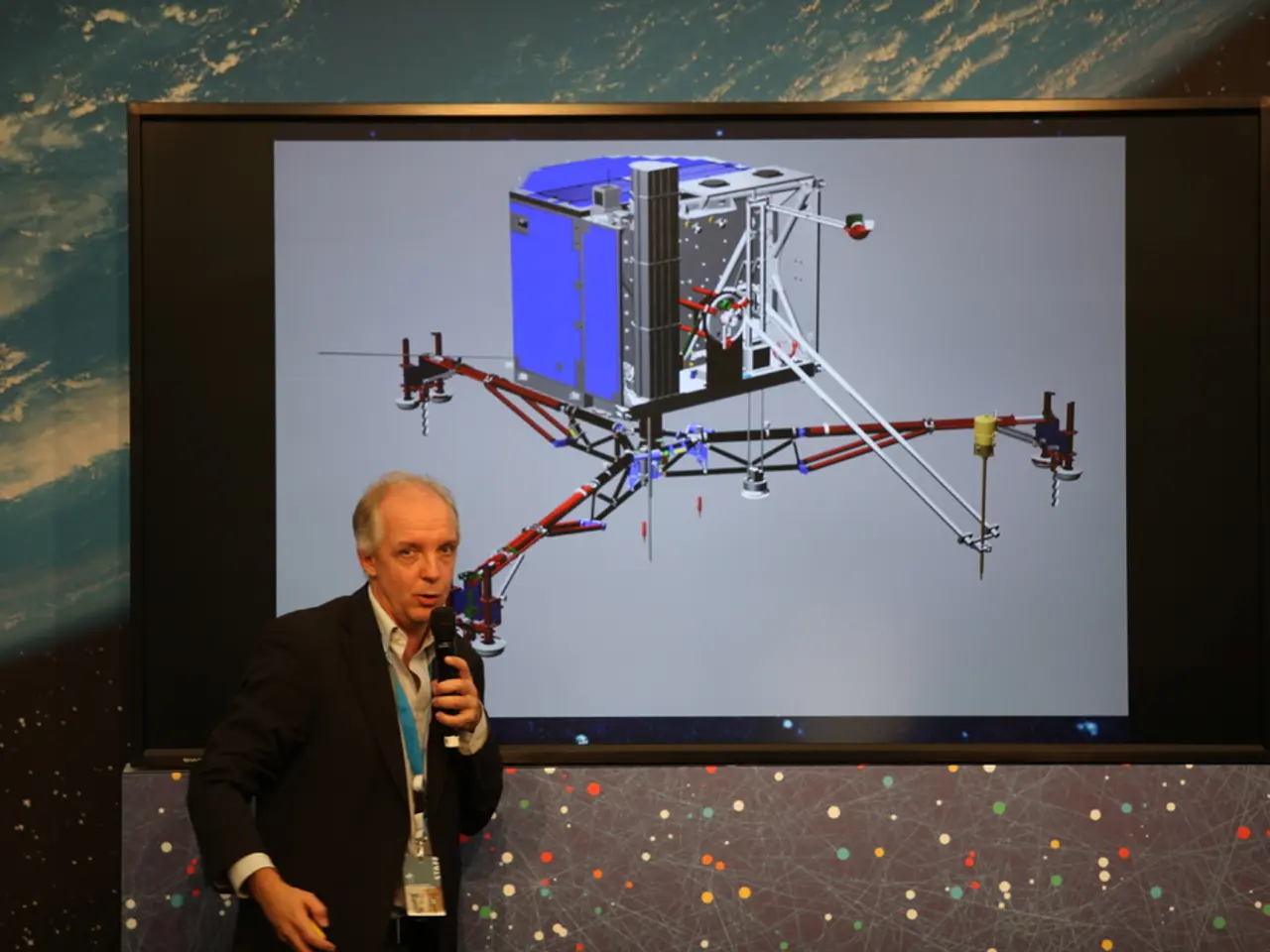
Based on the successful Phoenix Mars Lander mission, InSight is equipped with a suite of cameras, solar panels, and a robotic arm for deploying its scientific instruments on the Martian surface. The lander is designed and built by NASA's Jet Propulsion Laboratory (JPL) in Pasadena, California.
One of InSight's key objectives is to study the deep interior of Mars and provide information about the planet's seismic activity, heat flow, and geology. The lander is equipped with a seismometer, a heat probe, and a radio science experiment to carry out its mission.
The most significant discovery made by InSight is the detection of Marsquakes, seismic events similar to earthquakes on Earth. These events have allowed scientists to detect seismic waves traveling through Mars' core for the first time. This groundbreaking discovery confirmed that Mars has a completely liquid iron-alloy core rich in sulfur and oxygen, a composition that provides crucial clues about how terrestrial planets form, evolve, and possibly sustain life.
InSight's seismometer data has also helped probe the thickness of the Martian crust and mantle, opening new insights into the geological processes shaping Mars. This geophysical approach complements other missions like Perseverance that focus on surface geology, ancient water, and signs of past life.
Since its landing, InSight has measured Mars' heat flow, providing insights into geological activity on the planet. The data collected by InSight is helping scientists compare Mars with Earth and other rocky planets in our solar system.
The InSight mission's most important contributions include:
- First-ever direct study and confirmation of Mars' liquid, sulfur-oxygen rich core.
- Detection and analysis of marsquakes, enabling internal structure modeling.
- Enhanced understanding of differences between Earth’s and Mars’ interior essential for planetary science and astrobiology.
These breakthroughs represent major steps in Mars exploration and help refine strategies for future missions and our broader understanding of rocky planets. The InSight Lander is advancing our knowledge of planetary science and exploration and is part of NASA's Mars Exploration Program. It has paved the way for future missions to Mars and other planets.
References: [1] Banerdt, W. T., et al. (2019). Seismic investigation of Mars: First results from the InSight mission. Science, 363(6432), 1304-1309. [2] Banerdt, W. T., et al. (2020). The Martian crustal structure from the first year of InSight seismic data. Science, 367(6483), 1259-1264.
- The InSight Lander's discoveries in planetary science, such as the detection of Marsquakes and the confirmation of a liquid, sulfur-oxygen rich core, are significant advancements in space exploration, particularly in understanding the geological structure and evolution of Mars.
- The technology employed by the InSight Lander, including its seismometer, heat probe, and robotic arm, has expanded our knowledge in space-and-astronomy, offering valuable insights into the geology and seismic activity of Mars, and paving the way for future space exploration missions.