
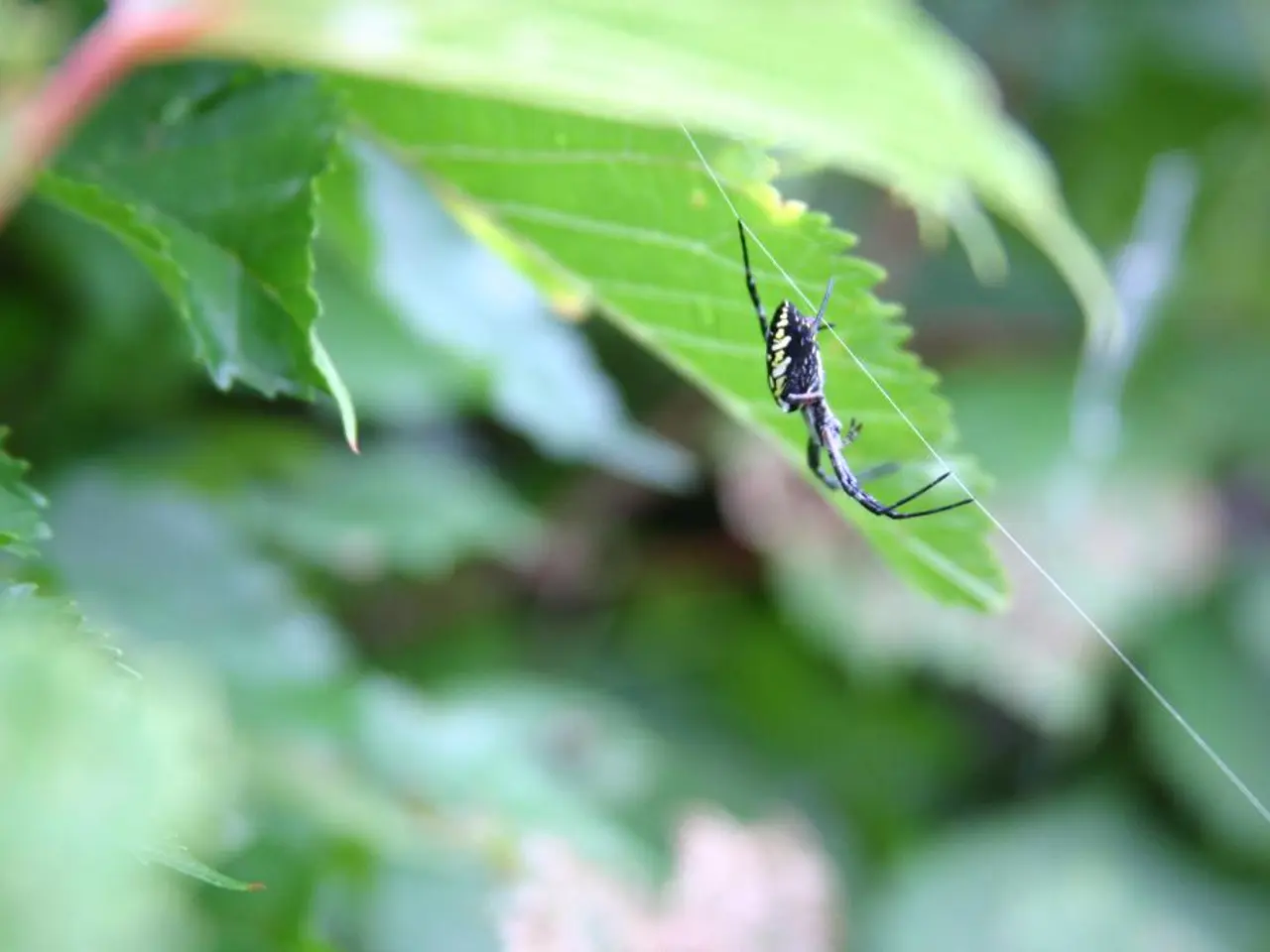
Marine-dwelling spiders may have been the precursors to land-dwelling spiders, according to a newly discovered well-preserved fossil.
In a groundbreaking discovery, a 500-million-year-old fossil named Mollisonia symmetrica has provided compelling evidence that spiders and their arachnid relatives may have originated in the ocean before making the transition to land. This fossil, which was previously thought to be an ancestor of a specific group of arthropods called chelicerates, has been the subject of extensive research.
The brain of Mollisonia appears to have been "flipped backwards," similar to modern spiders' brains. This unique organization, strikingly similar to that of modern spiders and arachnids, demonstrates that it was likely an early arachnid. The brain structure appears specialized for fast neural computation and motor control, useful for hunting and web-spinning behaviors seen in spiders.
This finding challenges the traditional view that arachnids diversified only after moving to land, suggesting an oceanic origin for the group. The neural arrangements in Mollisonia's fossilized brain are organized the same way as in modern spiders and their relatives, further supporting this hypothesis.
The Mollisonia's body composition was not like that of scorpions, but it did have a distinctive structure. The anterior part of its body contains a radiating pattern of segmental ganglia that control the movements of five pairs of segmental appendages. An unsegmented brain extends short nerves to a pair of pincer-like "claws," similar to the fangs of spiders and other arachnids. This evolutionary development in the arachnid brain is exclusive to arachnids.
The first creatures to come onto land were likely millipede-like arthropods and other ancestral, insect-like creatures. Early insects and millipedes were likely part of the Mollisonia-like arachnid's daily diet when it adapted to land. The Mollisonia-like arachnid's lineage likely gave rise to spiders, scorpions, sun spiders, vinegarroons, and whip scorpions.
The first arachnids on land may have also contributed to the evolution of insect wings. This evolutionary development, along with the discovery of Mollisonia, provides a new perspective on the origins and evolution of arachnids and their relatives.
This research, published in the journal Current Biology, has significant implications for our understanding of the evolutionary history of arachnids and their relatives. The arachnid brain, unlike any other brain on Earth, is now known to have evolved in marine environments during the Cambrian period. This discovery challenges the widely held belief that arachnids lived and diversified exclusively on land. Instead, it suggests that these fascinating creatures had a complex and rich history in the ocean before making their mark on land.
The groundbreaking discovery of Mollisonia symmetrica's fossil has sparked an international analysis of its brain structure, revealing similarities to modern spiders and arachnids that indicate an oceanic origin for these creatures. This newfound evidence calls for a reevaluation of how spider-like forms evolved, as it has been suggested that early arachnids might have played a role in the development of insect wings. The research published in Current Biology implies that the arachnid brain had complex neural arrangements before these creatures even set foot on land. Furthermore, the field of environmental-science will need to consider this new perspective when studying the evolutionary history of both terrestrial and marine life forms.